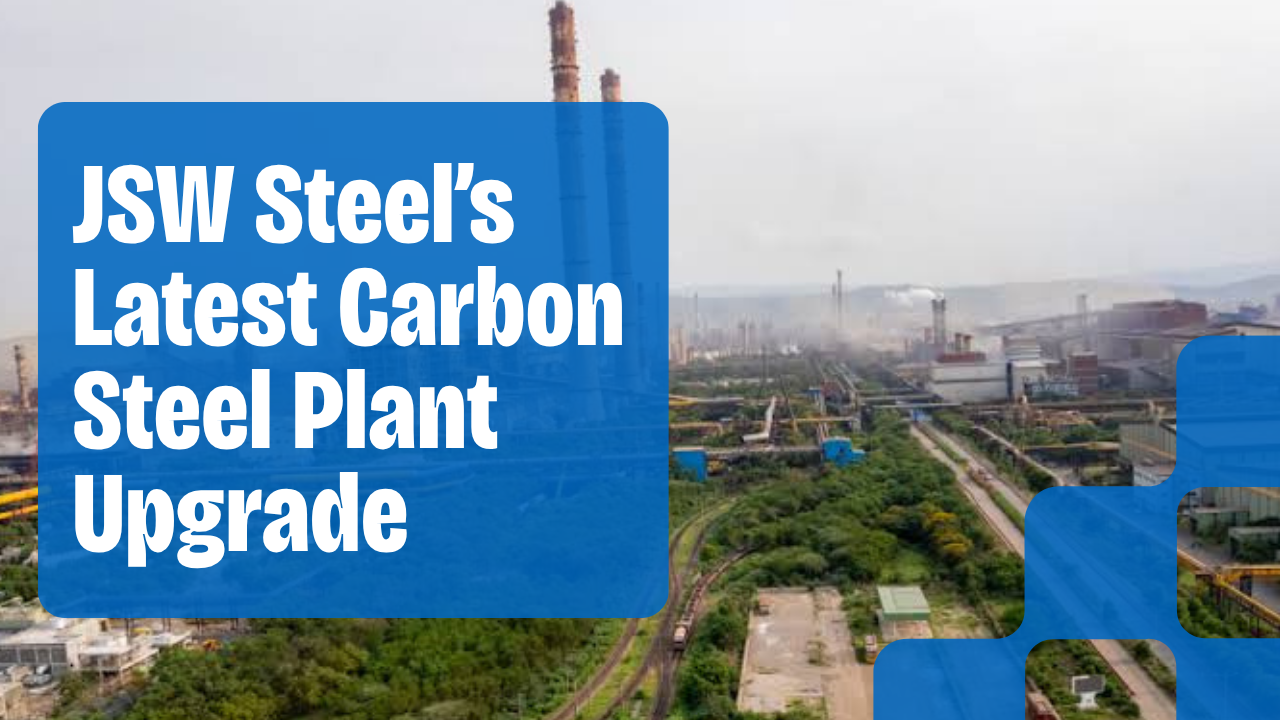
JSW Steel has been running one of the most active expansion programs of any Indian steelmaker over the past two years, with upgrades landing across multiple plants in quick succession through 2025 and into 2026.
Vijayanagar’s Blast Furnace 3 Upgrade
The most significant recent change came at Vijayanagar, where JSW completed the expansion of Blast Furnace No. 3 from 3 million tonnes per annum to 4.5 million tonnes per annum, restarting the facility in June 2026. The upgrade temporarily hurt output — April 2026 production was affected by the planned BF3 shutdown, with capacity utilisation excluding BF3 at around 94%, dropping to 83% when including the unavailable capacity. But once restarted, the plant quickly ramped up, operating at over 80% of its new capacity and contributing to higher volumes from the following quarter onward.
Dolvi’s Major Capacity Addition
At Dolvi, JSW ordered a 350-tonne BOF converter — among the largest installed in India — along with a twin ladle furnace and gas cleaning plant, a project expected to add 3.7 million tonnes of annual capacity. This follows an earlier-announced 4.5 million tonne blast furnace at the same site, which was set to lift Dolvi’s crude steel production by 45%, from around 10 million to 14.5 million tonnes annually.
Salem’s Capacity Boost
On a smaller but notable scale, JSW upgraded one of its casters in January 2026, followed by commissioning a new Ladle Furnace and Vacuum Degasser in February 2026. This lifted the Salem unit’s capacity from 1.0 MTPA to 1.15 MTPA, effective March 2026 — a modest but meaningful gain for its automotive-focused South Indian operations.
The Bigger Picture: FY26 Output
These upgrades, even with the BF3 disruption factored in, delivered results: JSW Steel’s combined crude steel production for FY26 reached 30.14 million tonnes, an 8% year-on-year increase, with capacity utilisation for Indian operations running at roughly 92% (excluding BF3) for the year.
What’s Next: The Paradip Greenfield Project
Beyond upgrading existing plants, JSW announced a greenfield steel mill project at Paradip, Odisha, with a planned annual capacity of 13.2 million tonnes — a project involving an investment of roughly $7.8 billion. Combined with a planned JFE Steel joint venture in Karnataka (a ₹5,500 crore investment), this positions JSW’s next phase of growth around both brownfield upgrades at existing sites and genuinely new production capacity in the east.
What This Signals
The pattern across Vijayanagar, Dolvi, and Salem shows JSW favoring quick, high-impact brownfield upgrades — new furnaces, casters, and converters at existing sites — to add capacity faster than building from scratch, while reserving greenfield investment (Paradip) for its next major capacity leap later in the decade.
