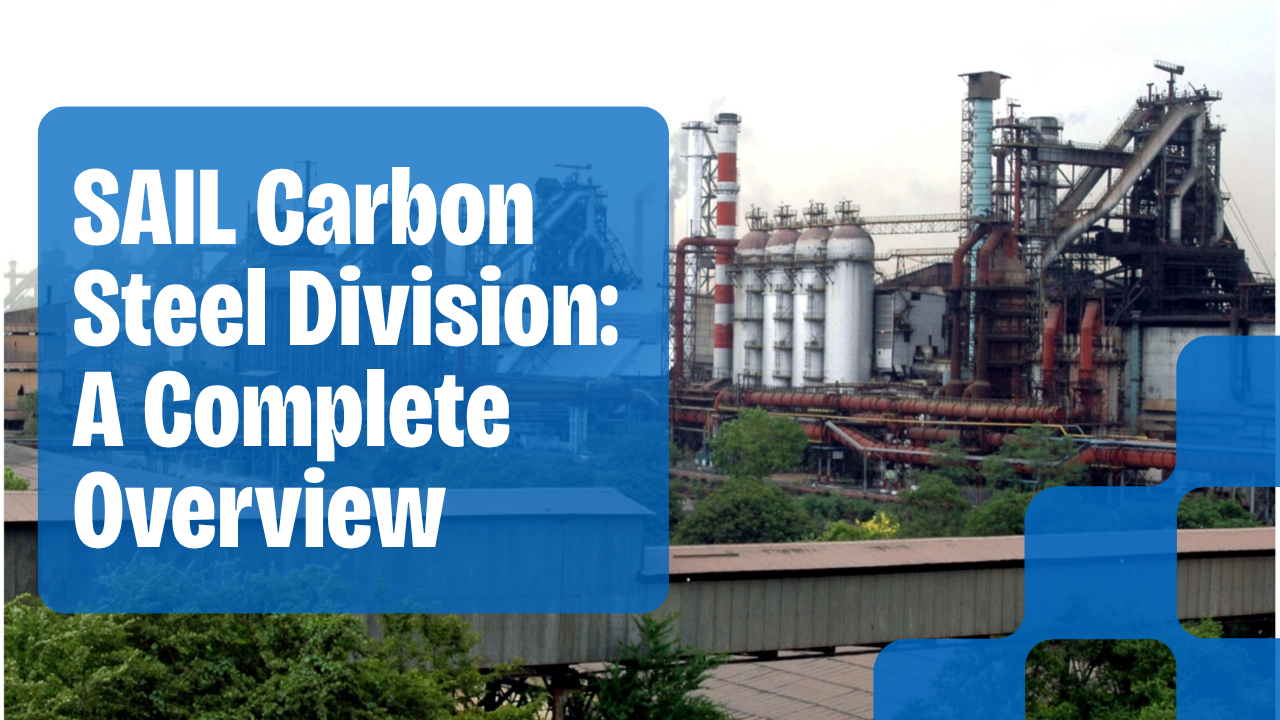
Steel Authority of India Limited (SAIL) occupies a unique position in India’s steel industry — it is the country’s largest steel producer and one of only seven companies holding “Maharatna” status, the highest tier of operational and financial autonomy granted to India’s Central Public Sector Enterprises.
Unlike Tata Steel or JSW Steel, which are privately promoted, SAIL is majority government-owned, making it as much a strategic national asset as a commercial steelmaker. Understanding SAIL’s carbon steel business requires understanding this dual identity, because it shapes everything from where SAIL builds plants to which sectors it prioritizes supplying.
Origins and Corporate Structure
SAIL was formed in 1973, consolidating what had previously been a scattered set of steel plants built during India’s early industrialization push in the 1950s and 60s — a period when the Indian government, working with international partners (the Soviet Union, West Germany, and the UK, among others), set up integrated steel plants as part of the country’s Second and Third Five-Year Plans.
This history matters: it explains why SAIL’s plants are concentrated in eastern and central India, close to the coal and iron ore belts of Chhattisgarh, Jharkhand, Odisha, and West Bengal, rather than being built for coastal export access the way JSW’s newer facilities are.
Today, SAIL produces iron and steel at five integrated plants and three special steel plants, giving it one of the most geographically distributed manufacturing footprints of any Indian steel company. This structure was deliberately built to serve India’s core heavy industries — railways, defence, and infrastructure — sectors where reliability of domestic supply has historically mattered more than pure cost optimization.
Carbon Steel’s Role in SAIL’s Product Mix
Where Tata Steel leans heavily into branded construction rebar (Tata Tiscon) and JSW pursues a diversified flat-and-coated product strategy, SAIL’s carbon steel output is oriented toward a different customer base entirely: government infrastructure, railways, and defence procurement, alongside general commercial and construction markets.
SAIL produces a broad range of carbon and alloy steels, supplying rails, plates, coils, and structural sections to infrastructure, railway, and defence customers — sectors that value long-term supply contracts and stringent quality certification over brand marketing.
This positioning is not incidental. As a government-owned entity, SAIL has historically been the default domestic supplier for Indian Railways’ rail requirements and for structural steel used in major public infrastructure projects — a captive-demand advantage that private players don’t have in the same way.
Current Scale and Market Position
As of early 2026, SAIL is the second-largest steel producer in India by volume, holding roughly 15% of the domestic crude steel market — behind Tata Steel and JSW Steel in overall capacity, but still commanding a scale that dwarfs most other domestic producers.
Estimates place SAIL’s current crude steel production capacity in the range of 20.63 million tonnes per annum at the consolidated level, though plant-level utilization and reporting can vary depending on which subsidiary units are included in a given count.
A Government-Backed Growth Plan
What sets SAIL apart from its private-sector peers most clearly is the scale and framing of its expansion ambitions. In line with the Indian government’s broader National Steel Policy target of reaching 300 million tonnes of national steel production capacity by 2030, SAIL has planned to raise its own crude steel production capacity to 35 million tonnes per annum by 2030-31 — a near-doubling of current capacity. The indicative investment required to reach that 35 MTPA target is estimated at around Rs 1,10,000 crore, with projects typically financed through a roughly equal mix of debt and equity.
This isn’t purely a commercial growth story — it’s explicitly tied to India’s industrial policy goals, meaning SAIL’s expansion decisions are shaped as much by national steel self-sufficiency targets as by pure market demand forecasting. Recent statements from SAIL leadership have reinforced this direction: at the International Metals and Metallurgy Summit (IMMS) 2026, the company’s Director (Finance) outlined SAIL’s capacity expansion plans alongside ongoing decarbonisation initiatives, signaling that future growth is being planned in tandem with emissions-reduction commitments rather than as a separate workstream.
Strategic Shift Toward High-Value Steel
Notably, SAIL’s Vision 2030 plan involves more than simply adding tonnage. Part of the reallocation of its capital expenditure — of the total investment pool exceeding Rs 1.1 trillion — is being directed toward high-grade, value-added steel specifically for defence and aerospace applications, marking a deliberate shift away from a pure-volume, commodity-grade strategy and toward higher-margin specialty products.
This mirrors a broader trend across the Indian steel industry (also visible in Tata’s and JSW’s expansion plans), where established players are using new capacity additions as an opportunity to move up the value chain rather than simply producing more of the same grades.
Raw Material Self-Sufficiency
One structural advantage SAIL holds over some competitors is its raw material backward integration. The company operates its own iron ore, limestone, dolomite, and coking coal mining operations, with total mineral production across these categories reaching approximately 36.89 million tonnes in a recent fiscal year — the large majority of this being captive iron ore.
This level of raw-material self-sufficiency reduces SAIL’s exposure to global commodity price swings compared to producers more dependent on open-market ore purchases, though it still remains reliant on imported coking coal, a dependency shared across virtually the entire Indian steel industry.
Why This Matters for Buyers and Industry Watchers
For anyone evaluating Indian steel suppliers, SAIL represents a genuinely different profile from Tata Steel or JSW Steel: government ownership brings both advantages (captive demand from railways and infrastructure, policy-aligned expansion funding, long operating history) and disadvantages commonly associated with public-sector enterprises (slower decision-making, project delays on capacity expansion, and a historically more conservative approach to marketing and branding compared to private competitors).
Its risk profile also differs — analysts have flagged dependence on imported coking coal and the pace of capacity-expansion execution as ongoing watch points for the company’s Vision 2030 targets.
In the articles that follow, we’ll break down SAIL’s specific plant locations and their individual capacities, recent production and revenue performance, the specific upgrades underway as part of its expansion plan, a review of its core carbon steel products, and where its steel actually ends up being used across Indian industry.
