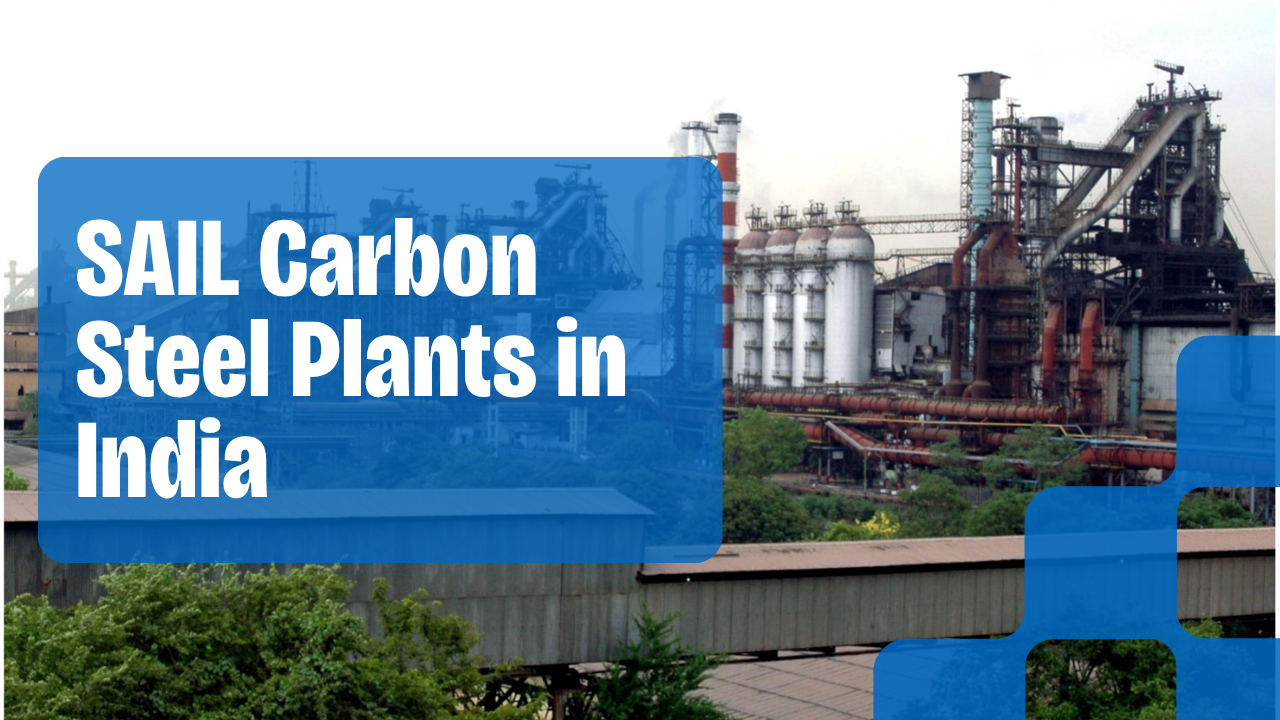
SAIL’s manufacturing footprint is unlike any other Indian steel producer — built not through acquisition or opportunistic expansion, but as a deliberate, government-planned network spanning five integrated steel plants and three special steel plants across five states. Each plant has its own distinct history, specialization, and role within SAIL’s overall carbon steel output.
Bhilai Steel Plant, Chhattisgarh
Bhilai Steel Plant (BSP) holds a unique distinction among Indian steel facilities: it is the country’s sole producer of 130-metre long single-piece rail track, the longest continuously rolled rail in the world, a capability directly tied to SAIL’s role as the primary domestic steel supplier for Indian Railways.
Following a major modernisation and expansion program, Bhilai’s hot metal production capacity was raised to 7.5 MTPA from an earlier 4.7 MTPA — the highest among all SAIL plants — with the upgrade including a new blast furnace, Blast Furnace No. 8 (“Mahamaya”), alone contributing 2.8 MTPA of capacity. The plant’s modernisation was implemented at a cost exceeding Rs 18,800 crore and was formally dedicated to the nation in 2018.
Bokaro Steel Plant, Jharkhand
Bokaro Steel Plant, built with Soviet collaboration during India’s early industrialization era, is one of SAIL’s flagship integrated facilities and a key contributor to the company’s flat products output, which feeds into automotive, appliance, and general engineering applications across eastern India.
Rourkela Steel Plant, Odisha
Rourkela Steel Plant (RSP) carries particular historical significance: located roughly 320 km from Bhubaneswar, it holds the distinction of being the first public sector steel plant in India, established in the 1950s with German collaboration. RSP became operational on February 3, 1959, when then-President Rajendra Prasad inaugurated its first blast furnace, named “Parvati.”
RSP is also central to SAIL’s future growth plans. Currently contributing around 4.4 MTPA to SAIL’s total steelmaking capacity, the plant is set for a major expansion — SAIL plans to invest Rs 30,000 crore to more than double RSP’s capacity to roughly 9.4 MTPA by 2030, a project spanning 1,200 acres that alone will account for approximately 25% of SAIL’s overall 35 MTPA target for that year.
The expansion is specifically designed to boost supplies to sectors including defence, oil & gas, shipbuilding, rail wagons, LPG cylinders, automobiles, and transformers — a significantly broader end-market ambition than the plant’s current output profile.
Durgapur Steel Plant, West Bengal
Durgapur Steel Plant (DSP), set up in the late 1950s, holds a notable niche: it is the only producer of forged railway wheels and axles in the country, an extremely specialized and defence/railway-critical product line unmatched by any private steel producer in India.
DSP’s crude steel capacity has grown progressively from an initial 1 MTPA in 1959 to 1.8 MTPA during 1990s modernisation, and further to 2.2 MTPA following its most recent Modernisation & Expansion Plan (MEP).
The plant’s finishing mills include a Merchant Mill producing special-quality TMT bars, a Section Mill for structural products (angles, channels, joists), and a new state-of-the-art Medium Structural Mill capable of producing next-generation parallel beams. Durgapur is strategically located 158 km from Kolkata, with strong rail and road connectivity via NH-19 and the main Kolkata-Delhi railway line.
Burnpur Steel Plant (IISCO), West Bengal
Burnpur Steel Plant, operating under the IISCO (Indian Iron and Steel Company) legacy name, rounds out SAIL’s West Bengal presence and contributes to the company’s long products portfolio alongside Durgapur.
Special Steel Plants: Salem, Durgapur Alloy Steel, and Visvesvaraya
Beyond the five integrated plants, SAIL operates three special steel plants with more focused product lines: Salem Steel Plant in Tamil Nadu (stainless steel, giving SAIL a presence in that category alongside its core carbon steel business), the Alloy Steel Plant in Durgapur, West Bengal, and the Visvesvaraya Iron and Steel Plant in Bhadravati, Karnataka — a facility established in 1918 that maintains a modest 0.35 MTPA capacity dedicated to alloy and special steels such as bearing steels, spring steels, and tool steels.
Total Capacity Snapshot
As of early-to-mid 2025, SAIL’s total steelmaking capacity stood at approximately 20.30 MTPA. For context on the scale of transformation this represents, SAIL had previously more than doubled its capacity in an earlier modernisation cycle — enhancing crude steel capacity from 12.8 MTPA to 21.4 MTPA, with Bhilai alone seeing its capacity rise from 3.93 MTPA to 7 MTPA during that phase.
Why the Government-Planned Layout Matters
Unlike Tata Steel’s concentration in Jharkhand-Odisha or JSW’s coastal-logistics-driven site selection, SAIL’s plant network was built with a different logic: proximity to India’s core coal and iron ore belts across five separate states, combined with strategic dispersal to serve railway and defence logistics nationally rather than optimizing purely for export or single-region market access.
This explains why SAIL, alone among major Indian producers, operates specialized single-purpose facilities (like Durgapur’s rail wheel and axle forging) that exist to serve specific government procurement needs rather than open commercial demand.
