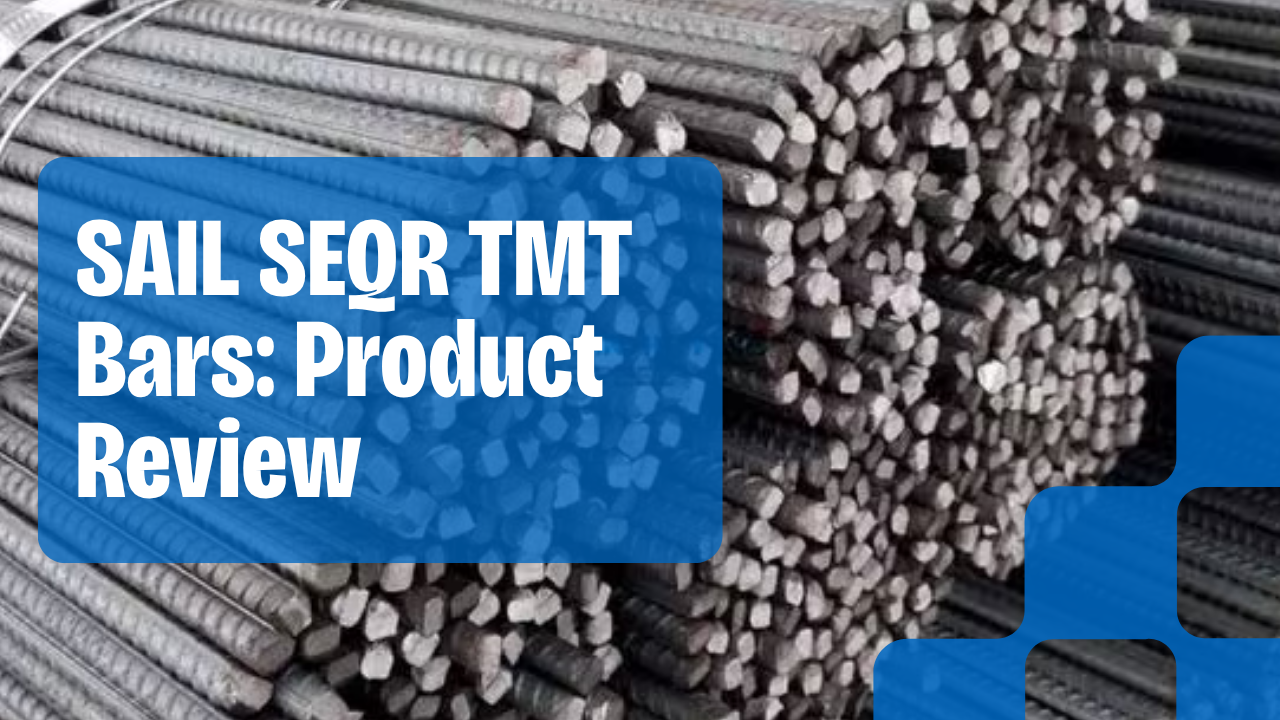
SAIL’s flagship carbon steel product for the construction sector is sold under the SEQR brand — an acronym for “Superior Earthquake Resistance” (also referenced in some technical literature as “Seismic and Quality Reinforcement”). As the reinforcement steel brand of India’s largest public-sector steelmaker, SEQR occupies a distinct market position: heavily favored in government, EPC (engineering-procurement-construction), and infrastructure tenders, where public-sector origin and consistent BIS compliance often matter as much as brand marketing.
Brand Positioning
Among Indian PSU manufacturers, SAIL SEQR TMT bars are widely preferred across government, EPC, and private sector developments due to their consistent quality, BIS compliance, and strong acceptance in technical and tender specifications. This is a meaningfully different value proposition than Tata Tiscon or JSW Neosteel, both of which lean more on consumer/retail brand-building — SEQR’s core strength is its default acceptance in institutional and government procurement processes, where specifying a PSU-manufactured product can simplify compliance and audit requirements.
Grades Available
SAIL TMT bars are classified into several grades: Fe 415, Fe 500, Fe 500D, and Fe 550, each suited to different structural applications. The SEQR line specifically emphasizes Fe500, Fe500D, and Fe550D grades — with Fe500D offering higher ductility, making it the preferred choice for construction in earthquake-prone regions.
For projects operating in high-corrosion environments, SAIL also offers a dedicated variant: SEQR-CR TMT bars, specifically engineered to protect against natural elements — comparable in purpose to Tata’s 550D or JSW’s CRS corrosion-resistant offerings, though marketed under its own distinct sub-brand.
Technical Performance
On strength metrics, Fe550 grade offers roughly 10% higher yield strength compared to Fe500, which can translate into potential material savings on large-scale projects through reduced cross-sections. Across the SEQR range, high-strength variants are noted to save up to 10-12% on overall construction costs due to their specific rolling design and application efficiency.
Quality Standards
SAIL TMT bars are manufactured in compliance with IS:1786-2008 standards, the same Indian standard governing competing brands, with specific requirements including a maximum carbon content of 0.30% and a minimum elongation of 14.5% — figures that directly affect both the bar’s strength and its ability to bend without cracking during construction, a critical safety property.
The bars also feature uniform and precise parallel rib patterns, rolled within close dimensional tolerance zones, which the manufacturer states supports both strength and a more reliable bond with surrounding concrete.
Notable Real-World Applications
SEQR bars have been used in some of India’s most significant infrastructure projects — reportedly including the Dhola-Sadiya bridge, India’s longest river bridge at 9.15 km, and the Tehri Dam, a project that used over 100,000 tonnes of reinforcement steel.
Beyond landmark projects, the brand is also specified for metro rail construction, where safety and longevity requirements in both underground and elevated structures place particularly stringent demands on reinforcement quality.
Pricing
As of 2026, SAIL TMT bar prices range from roughly ₹45 to ₹62 per kg across grades, with Fe550 and Fe600 commanding a premium over base Fe500. This places SAIL noticeably below both Tata Tiscon (₹58-70/kg) and JSW Neosteel (₹52-68/kg) — as a public-sector brand, SAIL consistently offers more competitive pricing compared to private-sector alternatives, a positioning that makes it a particularly attractive option for large-volume government and infrastructure procurement where cost efficiency at scale matters more than premium branding.
Where It’s Best Used
- Fe500/Fe500D: residential construction, general RCC work
- Fe550D: high-rise and commercial projects requiring higher tensile strength and ductility
- SEQR-CR: high-moisture or corrosion-risk zones
- Structural steel range (angles, channels, beams): heavy fabrication and industrial structures
Our Take
SEQR’s core advantage isn’t premium engineering differentiation from Tata Tiscon or JSW Neosteel — the underlying technical specs (IS 1786:2008 compliance, comparable grade offerings) are broadly similar across all three major brands. Its real differentiator is price-to-institutional-trust ratio: for large government and infrastructure projects where tender specifications often favor PSU-sourced materials and where budget efficiency at scale is a primary concern, SEQR’s meaningfully lower price point relative to private competitors makes it a natural default choice — a genuine advantage even if it comes with somewhat less brand polish in the retail/individual-homeowner segment.
